Population, Scale and Consequences: Sofia Pineda Ochoa responds to George Monbiot’s criticism of GREENWASHED
George Monbiot And The Question Of 10 Billion

I believe that inaccurate information about the environment is not merely irresponsible—it is deadly in the most literal sense. When the scale and urgency of environmental damage are misunderstood or downplayed, meaningful action is delayed or dismissed, and the consequences fall on living ecosystems.
Whales wash ashore with stomachs full of plastic because the true magnitude of our waste is obscured or normalized. Species populations collapse within decades when reality is ignored or misrepresented. Entire marine ecosystems are turned into dead zones as intensive fertilizer use continues unchecked.
In each case, I believe that inaccurate narratives don’t just confuse the public—they enable inaction that results in real, measurable harm.

My film, GREENWASHED, for example, highlights the plight of Pony, an orangutan used in a brothel whose story caused massive outrage (understandably so). In contrast, however, each year our demand for palm oil and other vegetable oils increases (in large part because, as our human enterprise grows, so does our demand for foods, detergents, soaps, fuels and other things that use vegetable oils).
This predictably results in mass deforestation, burning and suffering of orangutans, separation of their families, and horrific deaths of untold numbers of these highly intelligent, beautiful primate individuals.
However, this broader harm doesn’t seem to cause nearly the level of public outrage as the story of Pony does.

Like all other species with whom we share this world, orangutans have every right to exist and evolve on this planet. But they get burned, displaced and killed en masse, all because—well, because if every year our demand for oil crops grows, then someone will supply those oil crops.

Highlighting an example of what I perceive as serious dereliction in forthright communication about these issues by organizations, journalists and the media in general, the documentary includes an interview with an individual (Guardian columnist George Monbiot) whose work I’ve seen cited to downplay the importance of population in our environmental challenges, and who writes things like how the global impact of our population growth is “much smaller than many people claim”.
The film challenges his minimization of the role population has in our environmental problems, and his claim that we can have a human population of 10 billion people living “quite comfortably,” an idea he has also expressed in his writings.
In my opinion, these positions are difficult to stand by. And he doesn’t look great when asked for specifics in the relatively short part of the film in which he appears.
Now that the film is released, he has spent some time publicly expressing discontent about his inclusion in the documentary.
I’d love to see him use his time instead to discuss his claim that we can fit 10 billion people comfortably on this planet. Coming from a respected environmental columnist, this is something people believe, and I think it creates the impression that our numbers are not a problem worth addressing—because if we can add hundreds of millions more people and still somehow all live “quite comfortably,” then our current and projected numbers must not be such a big problem.
So, what would this 10 billion humans living comfortably on the planet actually look like? What assumptions is he making?

In addition, in his interview with me, George described a fair, green world that could exist, where everyone can have a nice lifestyle with access to things like beautiful public swimming pools, sports grounds, tennis courts, art galleries, gardens, etc., but in a way that would not impose on anyone’s ability to survive or the ability of the living planet to survive.
While I genuinely find this idea very nice and a worthwhile pursuit, even in our current situation, with billions of people living in abject poverty, we are seriously depleting and destroying the world’s ecosystems.
So, how would we be able to all have this nice lifestyle at our current (and still growing) scale, without imposing further on what’s left of the planet’s wildlife?

Currently, we’re using the equivalent of more than 40,000 trees’ worth of pulp every single day just to produce toilet paper. Every day. So how much would we use if there were millions and millions more humans than there are now, and how would that possibly be sustainable?
Of course, this is not about toilet paper. It’s about everything we use and consume, including things that are considered basic needs—whether toilet paper, soap, housing, transportation, electricity, and so on.

But instead of defending the claims he makes, this journalist opted for attacking my character. Maybe understandably, given the difficulty of defending these particular ideas.
I would normally not spend time responding to personal attacks—as anyone can watch the film, read his articles, and form their own opinion. But because he is a public figure whose views on environmental issues are influential, I thought it’s worth writing this so readers can better consider the ideas he conveys.
First, this journalist—someone who writes for a living and presumedly chooses words with care—really put his flair on display. He claimed that I “gravely misled” everyone who watched my film by suggesting we could alter the current human demographic trajectory.
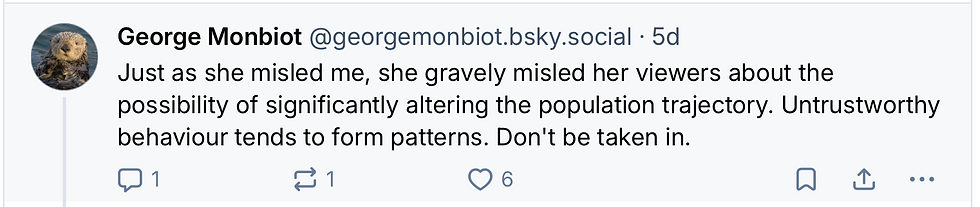
This is an extraordinary accusation. Taken seriously, it implies that unless one believes there is nothing on Earth that could ever meaningfully alter the current human population demographic trajectory, then one is guilty of being misleading.
By that logic, all organizations and individuals working to influence population trajectories through education, healthcare and women’s rights must also be misleading the public.
I guess Alisha Graves, featured in the film and working at UC Berkeley’s Sahel Program to expand access to healthcare and women’s rights in parts of Africa, is misleading audiences when she says that population is a factor amenable to change while fully respecting human rights?

I guess Nandita Bajaj, also featured in the film and director of Population Balance, is deceiving the public by trying to alter the trajectory by advocating for rights-based approaches that center human dignity and the rights of nature?

The implication is self-evidently absurd.
Labeling disagreement as “misleading” simply because one rejects his assertion that population growth is immutable may be a rhetorical move that plays well on social media, but it is, however, a curious choice of words for a respected columnist.
Also, the underlying premise—that human behavior can change in virtually every single domain except reproduction—is, in my opinion, very strange. As a physician who specializes in human behavior, I am unaware of any principle—biological, psychological or social—that renders family planning uniquely immune to change.

A central message of GREENWASHED is my deeply held belief that if we were forthright about how the sheer scale of our human enterprise is obliterating wildlife, and the ecosystems and resources on which we all depend—many more people would, of their own accord, choose to have fewer children or adopt.
This would change our current demographic trend and lead to a decline in population and a shift toward a more sustainable, less destructive human footprint. I believe this because I think a great many people, even if not all, do care deeply about wildlife—and everyone for sure cares about their own survival—so many would approach family planning differently if they were aware of the full extent of the harm that our current scale is causing.
But instead, what they hear are things like we “can have 10 billion people living quite comfortably” within our planetary boundaries. So, unfortunately, I think most couples don’t think our numbers are a problem and don’t think about the planet when planning their families.

In one blog post that George published criticizing the film, he expressed that it clings to old ideas and that population concern distracts from things we can change, such as adopting a plant-based diet.
This is a curious point to make, given that GREENWASHED devotes substantial time to promoting plant-based diets and makes that case forcefully and at length. These remarks give the impression that he was criticizing the film without watching it.
I had assumed that when a someone publishes a critique of a film, it’s after viewing it. I suppose that assumption does not always hold.

Speaking of plant-based diets, as a long-time vegan myself, I very much appreciate and value all of the thoughtful work that George has published over the years highlighting the inherent inefficiencies of animal foods and the devasting impacts that animal agriculture has on the environment.
He said some very thoughtful and persuasive things about animal agriculture when I interviewed him, and given that GREENWASHED devotes a significant amount of time to promoting plant-based diets, I was very much looking forward to including high-quality clips of him making that case.
However, during editing, I discovered that he—whom I had believed to be vegan—had appeared on television promoting the eating of squirrels, including skinning and cooking one on BBC Newsnight, and I found footage of him shooting and killing a deer while filming a television program. In the end, I ultimately did not feel inclined to include him in that section of the film, despite the thoughtful things he said about plant-based diets and the harms of animal agriculture.
Other vegans clearly see this differently, as his publicly skinning/killing of animals on television doesn’t appear to have affected his standing within vegan circles; he continues to be invited as a keynote speaker at events such as the upcoming Vegan Camp Out.

George, who has written extensively about population and who people seem to consider as knowledgeable on this topic, also complained on social media that he didn’t know population would be a topic of the film (text of that part of his post below, and his thread here).
George Monbiot @georgemonbiot.bsky.social:
2. Far from it: here's the email she sent inviting me to take part. Nothing suggesting it would in any way be an attack on my position. There was lots of further correspondence, but none of it even mentioned the topic of the film: population growth. Had I known, I would have prepared.
Hi Mr. Monbiot,
My name is Sofia Pineda Ochoa, I’m a physician in Houston and co-founder of the non-profit “Meat Your Future”, which raises awareness about the detrimental impact of our society’s use and consumption of animal foods.
We are currently producing a sequel to our environmental documentary”Endgame 2050″ (I have copied the trailer below).
- Trailer: https://youtu.be/_PTtF6btAxU
We would like to include an interview with you. We know you’ve been an outspoken advocate for many years on these issues, and would appreciate being able to speak with you about the environmental challenges the planet is facing.
Would you have any availability for a remote Zoom interview over the next month or so? Please let me know, as well as any questions or further information that may be helpful.
Thanks so much,
Sofia
How surprising for George Monbiot, an environmental journalist, to bizarrely claim that population isn’t somehow an “environmental challenge the planet is facing.” And, he almost made it sound like I did something similar to what Sacha Baron Cohen might do, a guy who changes his name and sets up different entities to trick high profile people into doing interviews to make them look bad.
Yet, in this case, he’s posting the email I personally sent him…which specifically mentions my earlier film, Endgame 2050 (that discusses population extensively), includes a link to its 2-minute trailer (which includes Paul Ehrlich—arguably the most recognizable figure on the topic of population), and includes my full name (which anyone can Google).
George told me when I interviewed him that he pioneered the genre of investigative environmental programs within the BBC. So, it was genuinely surprising to me that anyone (let alone a sophisticated journalist who pioneered an investigative genre) would claim now he had no idea that I would have an interest in discussing that topic.
But I suppose if you don’t bother taking even one minute to look up the person who will interview you, and you don’t bother watching the 2-minute trailer she sent you, and you don’t bother watching the film she told you she made before agreeing to be in her next film, well, then I guess that’s possible.

George closed a recent blog/post by affirming that he “rail[s] against” population concern (an attitude which, I think, reinforces the points the film makes). In my view, that’s also a deeply privileged—and troubling—position.
It is remarkably convenient for someone living a very comfortable life in the U.K. to proudly rail against the issue of population—whether that means dismissing it, minimizing it, or attacking those who raise it as an issue—while so many humans and other living beings elsewhere are already profoundly affected by the challenges our unsustainable population brings.
For example, Mexico—the country I’m from—grew from roughly 15 million people in 1915 to more than 133 million by 2025.
Its citizens are now suffering from shortages of infrastructure and basic resources; water, in particular, has become a serious problem in many regions.
Even my own mother, who lives in Guadalajara, has had spats with neighbors over people drawing more water than allotted from her building’s shared water tank.

On top of that, Mexico devotes large amounts of water, soil and fertilizer to growing foods to export to wealthier nations (such as the U.K.) that are unable to sustain their own large and unsustainable populations, and therefore rely on extracting primary resources from elsewhere to support themselves.
Perhaps when shopping at a supermarket in the U.K., it can give the impression that population is not a problem worth addressing—shelves are full and abundance appears effortless.
But many of the foods readily available there come at a significant environmental cost elsewhere.

For example, food production for export contributes to deforestation and water shortages in Mexico; asparagus consumed in the U.K. has been linked to severe water depletion in Peru; and green beans commonly sold in the U.K. are often imported from Kenya, a country already under extreme water stress.

We are at a point where our plastic use is so vast that even replacing it with biodegradable materials would itself be incredibly devastating and deforesting. At the same time, our plastic waste is literally causing whales to wash up on beaches, weak and dying, because they can no longer absorb food or nutrients as their stomachs are filled to the brim with plastic.
Because now, when whales open their mouths to filter the large amounts of water they naturally rely on to trap food, what gets trapped instead is our plastic waste, which now reaches every corner of the planet.
When our scale is causing this level of suffering and harm, I personally find it cruel, in my opinion, to affirmatively “rail against” population—or indeed to assert that we could have millions more humans living comfortably on the planet.

Koalas are animals that move slow and are meant to live in trees. And we have seen images of these precious animals with burned eyes, burned paws, and burned lungs because their one and only home goes up in flames as the changing climate has rendered their forests more prone to fires. The IPCC states that population growth is one of the two leading drivers of greenhouse gas emissions.
But yet one sees limited awareness on this. Since the very recent start of the first COP meeting in 1995 (so recently that I was already a teenager, and I still consider myself young(ish)!), the global population has grown from 5.7 billion to 8.2 billion.
In this extremely short blink-of-an-eye, the population increased by more than two thousand million people. Think of one million people, then multiply that by a thousand, then by two—and it is more than that.
I think it is irresponsible for scientists, media, organizations, and governments to dismiss such an important and well-established contributor of greenhouse gases (instead of addressing all of the drivers, which is what we should be doing if we are serious about addressing the climate crisis).
But more than that, I find it downright unconscionable, in my opinion, to affirmatively “rail against” population when koalas are literally crying—scared and confused, being incinerated—while population growth remains an established contributor to greenhouse gas emissions.

Close to where I live, there is a piece of “unused” land that, while relatively small and in the middle of an otherwise vastly developed area, has become a refuge for some wild animals.
This tiny sliver of green brims with elegant and beautiful deer, opossums, raccoons, skunks, snakes, coyotes, owls, nutria and more.
I walk there almost every day, and often see the same animals in similar places (there’s one clumsy opossum who I always see close to a tree where he probably lives). They go about their lives, trying to make a living, and minding their own business.

The only reason why these animals are able to live in this “empty” land for now is it was purchased by the county for future projects.
But the county has now announced that it’s planning to turn this land into a bunch of large water retention structures (since the surrounding area has been overdeveloped, with houses as far as the eye can see, and has become more prone to flooding).
The thought that these animals that I see almost daily will lose their home (realistically, they will die) makes me want to throw up.
I see their cute little serious faces every time I walk there, and I cannot begin to tell you what a tragedy it will be for these precious animals, and how much they will suffer when that happens.

Even as trucks have started entering that area periodically for initial “clean up” and preparations, you can see the animals become scared and rattled.
Imagine their immense fear and despair once we actually start tearing down trees and brush to dig and build these structures. But that is the reality of our scale and our growth.
A painful and palpable reality of suffering, as we take every square inch for ourselves (for homes, farms, roads, schools, materials, water retention, etc.) and leave nothing for them.

I find that George’s complaints (what I see as deflections) reinforce the very points the film makes, but this gives me no satisfaction since the consequences of both our scale and our growth continue to unfold in real time.
While George, who is a credible environmental journalist writing for a credible publication— proudly says he “rail[s] against” population concern—I find myself thinking about the deer I see near my home and feel genuinely afraid for them. What will happen to them? What chance do they have at surviving once that area is developed?
I suppose the only consolation I have at this time is that at least there is an entire ocean between those deer and George and his deer-hunting antics.

I am genuinely grateful for all of the conversations this film has sparked, and welcome any and all discussions on these important topics. Debate, disagreement, and scrutiny are not only inevitable—they are necessary. My hope is that people watch the film for themselves, read widely, and think carefully about the ideas being advanced and the consequences they carry. The stakes are too high, and the lives affected too real, for anything less.


Comments